Fractions used to feel like a math trick I could use properly but never quite see through.
I could — find the LCM, multiply the numbers, flip and divide but I didn’t really know what was actually happening behind the scenes of these rules or steps.
It felt like walking blindfolded through rules someone else wrote down long ago.
That’s why I’m trying to slow down, go under the layer of steps,
and understand what’s really happening behind those “just follow this” moments.
Why We Take the LCM
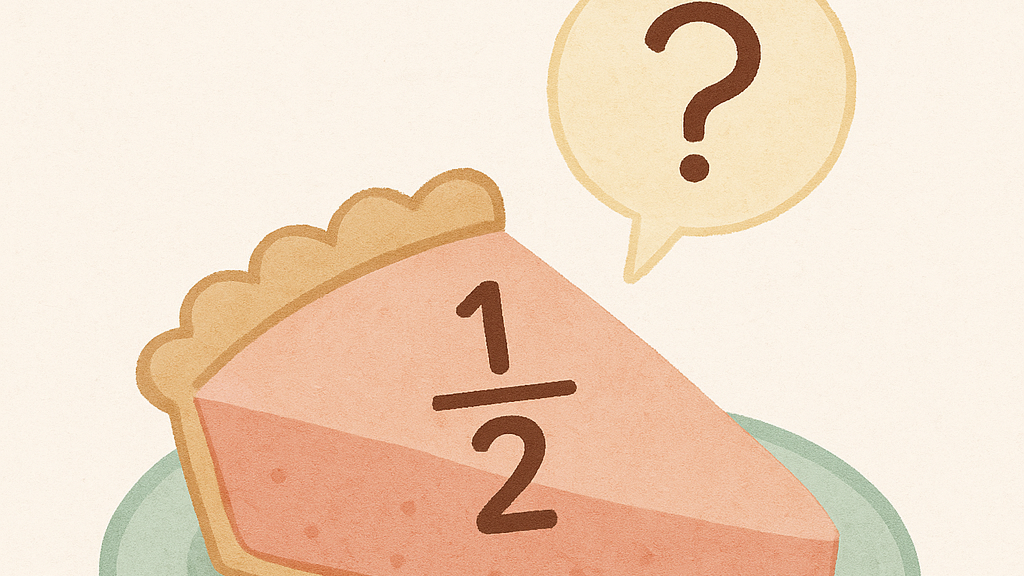
I know what LCM means by definition,
but taking the LCM isn’t just about numbers or forcing denominators to match.
It’s more like breaking each fraction’s whole into smaller and smaller pieces
until every piece from one matches in size with every piece from the other – until they finally share the same kind of part.
So, it’s all about finding a fair, shared scale of comparison.
Visualizing the Problem
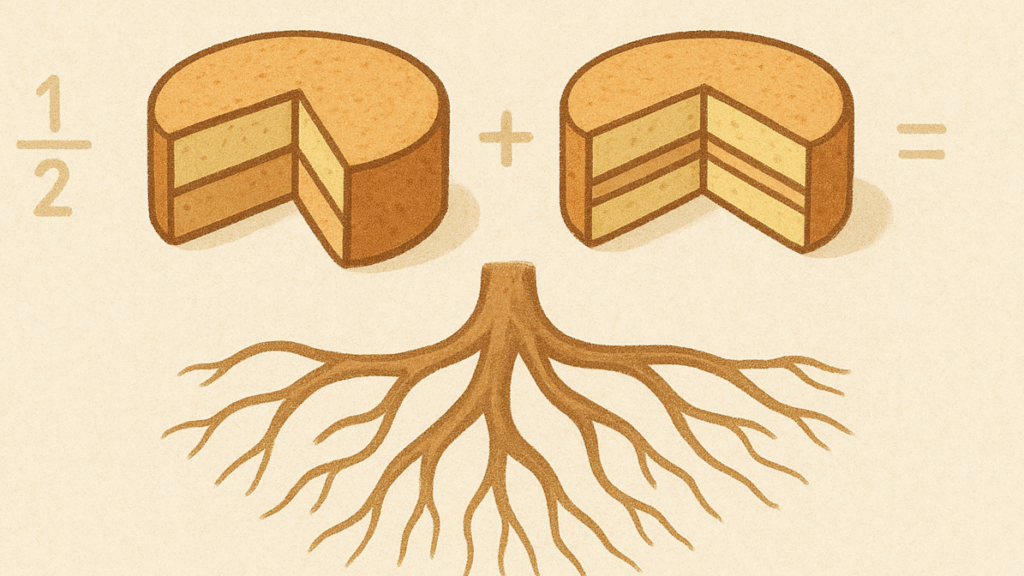
Hold on, hold on for a second — lemme picture something simple.
Imagine two friends — you and me — both sitting with a cake each.
I cut my cake into 2 equal slices. Each slice is half of my cake — 1/2.
You, on the other hand, cut yours into 3 equal slices. Each slice is a third — 1/3.
Now, I ate one slice of my half-cake,
and you ate one slice of your third-cake.
If I ask, “Who ate more?” something doesn’t feel right, right?
It’s hard to really compare 1/2 and 1/3 just yet
because the slices of each cake are of different sizes.
So before we can add, compare, or even decide who ate more, we need both cakes to be cut into slices of the same size — so that there’s a single, shared slice size that makes sense for both.
🍰 So What Does “Finding the LCM” Actually Do Here?
When we “find the LCM” of the denominators — in this case, 2 and 3 —
what we’re really doing is finding the smallest slice size that both cakes can be cut into so that a piece from one cake is exactly equal in size to a piece from the other.
Let’s see what that looks like:
- Multiples of 2 → 2, 4, 6, 8, …
- Multiples of 3 → 3, 6, 9, …
The first number they share is 6, so our LCM is 6.
This means both cakes can be re-cut into 6 equal slices each.
Now both yours and mine have slices of the same size — sixths.
Meaning, 1/6th slice of one cake will now be equal to 1/6th slice of the other.
Let’s See How That Works
So, I ate half of my cake. But wait — before that, I had a whole cake that was cut into 2 big pieces.
Now, if I want to cut those 2 big pieces into 6 equal tiny pieces, what should I do?
Each big half must be cut into 3 smaller pieces. That way, both halves together make 6 equal slices.
Mathematically, this is like finding how many times the “old number” (2) can be cut each to get “new number” (6) i.e. LCM . We divide 6 by 2 and get 3 — meaning each half needs to be split into 3 smaller parts.
That’s how we make sure every piece is fair and equal!
So, after re-cutting my cake into 6 small pieces:
Half of the cake means I ate 3 of those tiny pieces — 3/6 of my cake.
Simplifying it gives 1/2, which justifies I ate half of the whole cake.
And similarly,
you ate one-third of your cake. But wait — before that, your whole cake was cut into 3 big pieces, right?
Now, if you want to cut those 3 big pieces into 6 equal tiny pieces, what should you do? 🤔Intuitively, each big piece must be cut into 2 smaller pieces.
Mathematically, using the LCM idea — we check how many times each of 3 pieces can be cut to get 6 equal parts.
We divide 6 ÷ 3 = 2, meaning each 1/3rd piece needs to be split into 2 smaller parts.
So, one-third is the same as 2 out of 6, or 2/6.
That’s how we make sure every piece is fair and equal! 🍰
Now look — our cake pieces are the same size!
Each small piece is a “sixth.” I ate 3 sixths, and you ate 2 sixths. So together, we ate 5 sixths of a cake – that’s almost the whole cake, just one tiny slice left!
What This Cake Story Really Tells Us

And that’s really what this whole cake story was about!
No matter what we want to do with fractions — add them, compare them, or even subtract them — we first need their pieces to look and feel the same.
That’s exactly what finding the LCM helps us do.
It’s like saying, “Hey, let’s make sure both cakes are cut into equal slices before we start sharing or counting.” Once everything is cut into the same-sized pieces, every operation — addition, subtraction, comparison — suddenly becomes simple, fair, and natural.
So next time you’re working with fractions, don’t just think of “LCM” as a math rule —
think of it as the step that makes every part equal, so the whole picture finally makes sense!
We’ve seen how fractions find balance through LCMs — next time, we’ll dive into the confusion around why multiplication and division work the way they do in fractions.
And…, If you enjoyed this little dive into fractions, you might like to see where it all began — 🌱 Rooting Deep. It’s a short read about what this space is really about — slowing down and learning the core of things.